Purchases through affiliate links may earn Layer Zero a commission at no extra cost to you. Affiliate funding and disclosure policy
Fused Deposition Modeling (FDM)—also referred to as fused filament fabrication—remains the most accessible method for creating physical objects from thermoplastic spool stock. The technology feeds solid polymer line through a heated block, forcing softened plastic through a narrow orifice onto a moving plate, layer by horizontal layer.
In recent years, the baseline expectations for domestic FDM machines shifted dramatically. Manual paper leveling is largely giving way to strain sensors or probe-based offsets, print head kinematics move faster, and multi-spool automated feeder systems are becoming mainstream. However, manufacturer marketing numbers often blur the line between theoretical mechanical maximums and reliable everyday output. Choosing an FDM printer requires understanding how mechanical rigidity, extrusion flow limits, bed leveling systems, and filament management intersect in real domestic workspaces.
Key Decisions When Selecting an FDM Machine
Three Critical Evaluation Criteria:
- Kinematic Speed vs. Melt Flow: A printer advertised at 600 mm/s travel speed can only deposit plastic as fast as its hotend can melt it. High print speeds require sufficient volumetric flow and aggressive part cooling.
- Single-Nozzle Multi-Color Systems: Feeding multiple colors through one nozzle requires retracting, cutting, and purging plastic on every color change, introducing cycle overhead and scrap purge towers.
- Bed Construction and Leveling: Direct sensor-based compensation and flexible textured spring-steel (PEI) build plates minimize initial layer adhesion failures.
1. High Speed vs. Volumetric Flow Constraints
Modern marketing heavily promotes linear head speeds reaching 500 to 600 mm/s. While stiffened chassis and input-shaping firmware can indeed coordinate stepper motors rapidly without excessive vibration artifacts, real-world throughput is constrained by the hotend's volumetric flow rate (measured in cubic millimeters per second). If the heater cartridge cannot melt filament quickly enough, pushing the print head at top speed results in underextrusion, weak layer bonding, or extruder clicking. For everyday functional prints, practical sustained perimeter speeds are often considerably lower than theoretical acceleration ceilings.
2. Multi-Color Management: The Purge and Waste Reality
Multi-color printing on consumer FDM hardware typically relies on an automated external multi-spool box that feeds individual lines into an active toolhead via multiplexed PTFE tubes. While this allows complex chromatic models without manual mid-print pauses, buyers should note two trade-offs:
- Purge Waste: Because color changes share a single hotend, the machine must purge old pigment each time it switches hues, creating "purge poop" or purge towers that can consume notable filament volume on tall, multi-hued prints.
- Filament Handling & Moisture: Feeding four to eight spools simultaneously demands active dry storage or desiccant enclosures, as hygroscopic materials like PETG and PLA absorb ambient moisture when left exposed.
3. Motion Architecture: Bedslingers vs. CoreXY Frames
Cartesian "bedslingers" shift the build plate back and forth along the Y-axis while the toolhead handles the X and Z axes. This setup is cost-effective, but moving a heavy print bed at aggressive accelerations risks print wobbling on tall, slender geometries. Box-style CoreXY frames move only the lightweight toolhead along the top gantry while the bed steps downward along the Z-axis, allowing higher accelerations with less mechanical backlash.
---Current FDM Hardware Profiles
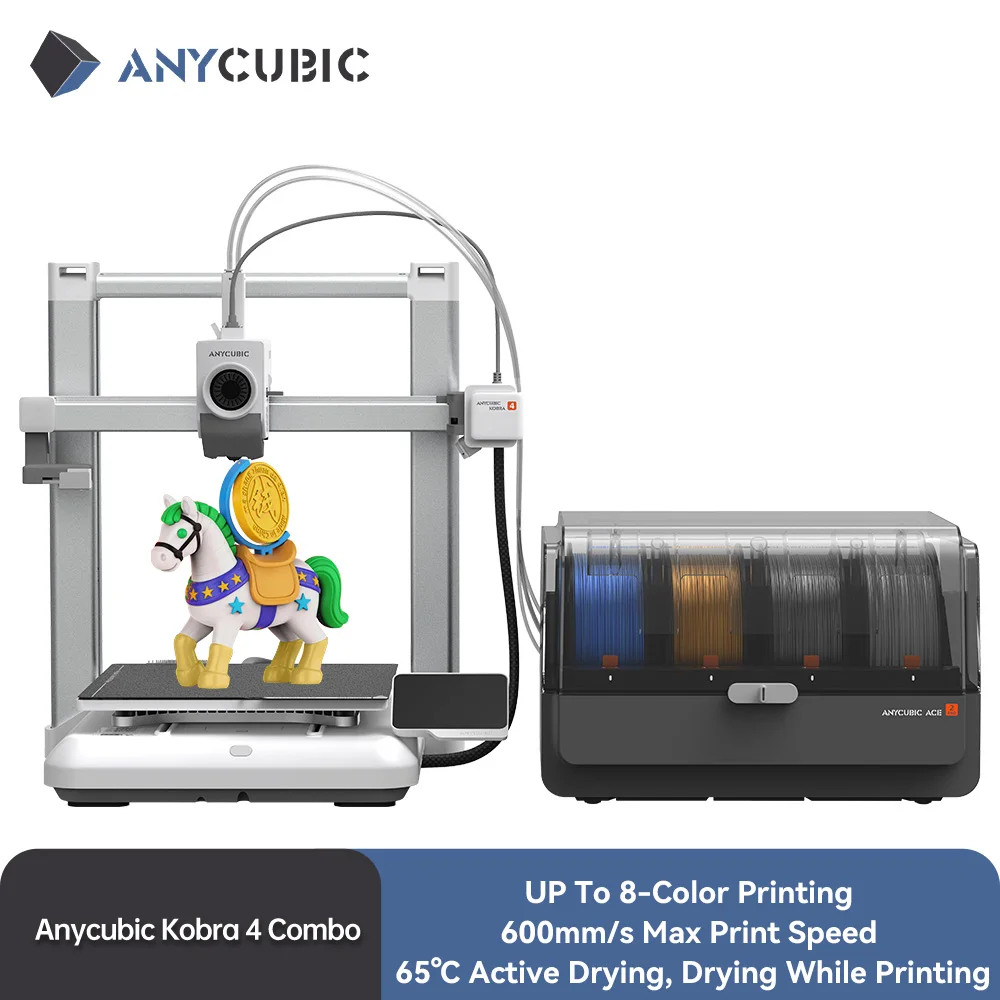
Anycubic Kobra 4 / Kobra 4 Combo
The Anycubic Kobra 4 platform represents the brand's approach to high-speed desktop FDM, advertised with speeds up to 600 mm/s and multi-filament management. In its "Combo" configuration, the unit pairs with an external ACE 2 Pro module designed to feed multiple filaments into a single print head (advertised up to 8 colors across compatible setups) while featuring an active drying chamber with stated warming capabilities up to 65°C.
- Target User: Hobbyists wanting colorful figurines or multi-shade functional parts who also need active drying for damp filament lines.
- Practical Compromises: Advertised 600 mm/s velocities are peak theoretical metrics; standard printing speeds vary with material flow. Verify before purchasing whether the specific variant listing includes the base single-spool printer or the full ACE multi-color bundle.
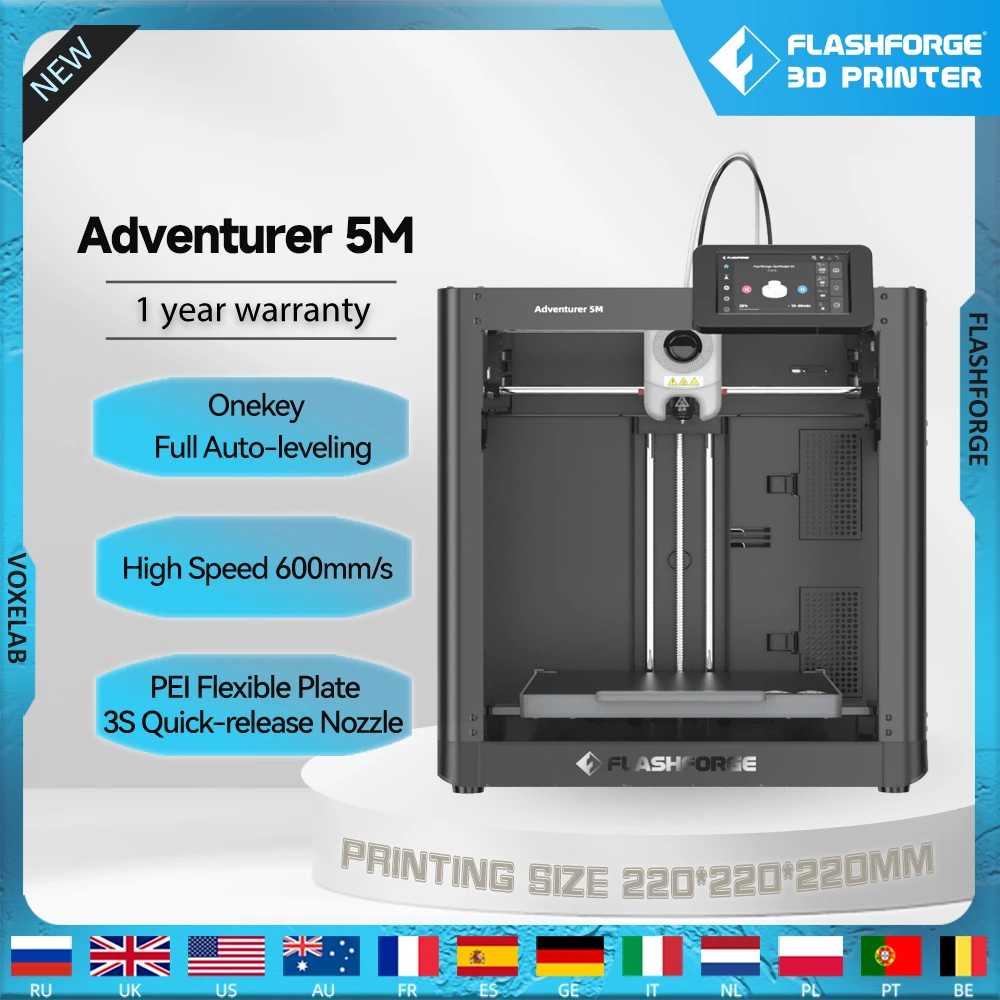
Flashforge Adventurer 5M
Flashforge's Adventurer 5M is a core-style desktop machine featuring an open frame, direct-drive extruder, full-auto bed leveling, and a flexible textured PEI build plate. The listing emphasizes a quick-swap nozzle assembly, high acceleration kinematics rated up to 600 mm/s, and power loss recovery.
- Target User: Users looking for a rapid, dedicated single-material prototyping machine with minimal bed-leveling calibration hassle.
- Practical Compromises: Because it is an open-frame printer without an enclosed chamber, temperature-sensitive engineering plastics (such as ABS or nylon) remain prone to warping due to ambient room drafts. Stick to PLA, PETG, and TPU unless adding an enclosure.

Flashforge AD5X
The AD5X adapts Flashforge's core platform for automated multi-material delivery, featuring an integrated multi-spool feeder mounted to the frame, one-click leveling, and fleet management group control. It handles continuous multi-spool printing through automated switching mechanisms.
- Target User: Makers requiring automated color transitions, multi-material signage, or automated spool failover for long print runs.
- Practical Compromises: Multi-material changes on a single nozzle introduce purge cycles that increase overall job duration and scrap rates. Check listing details to confirm whether spool dry boxes or side-mount brackets are included in the base package.
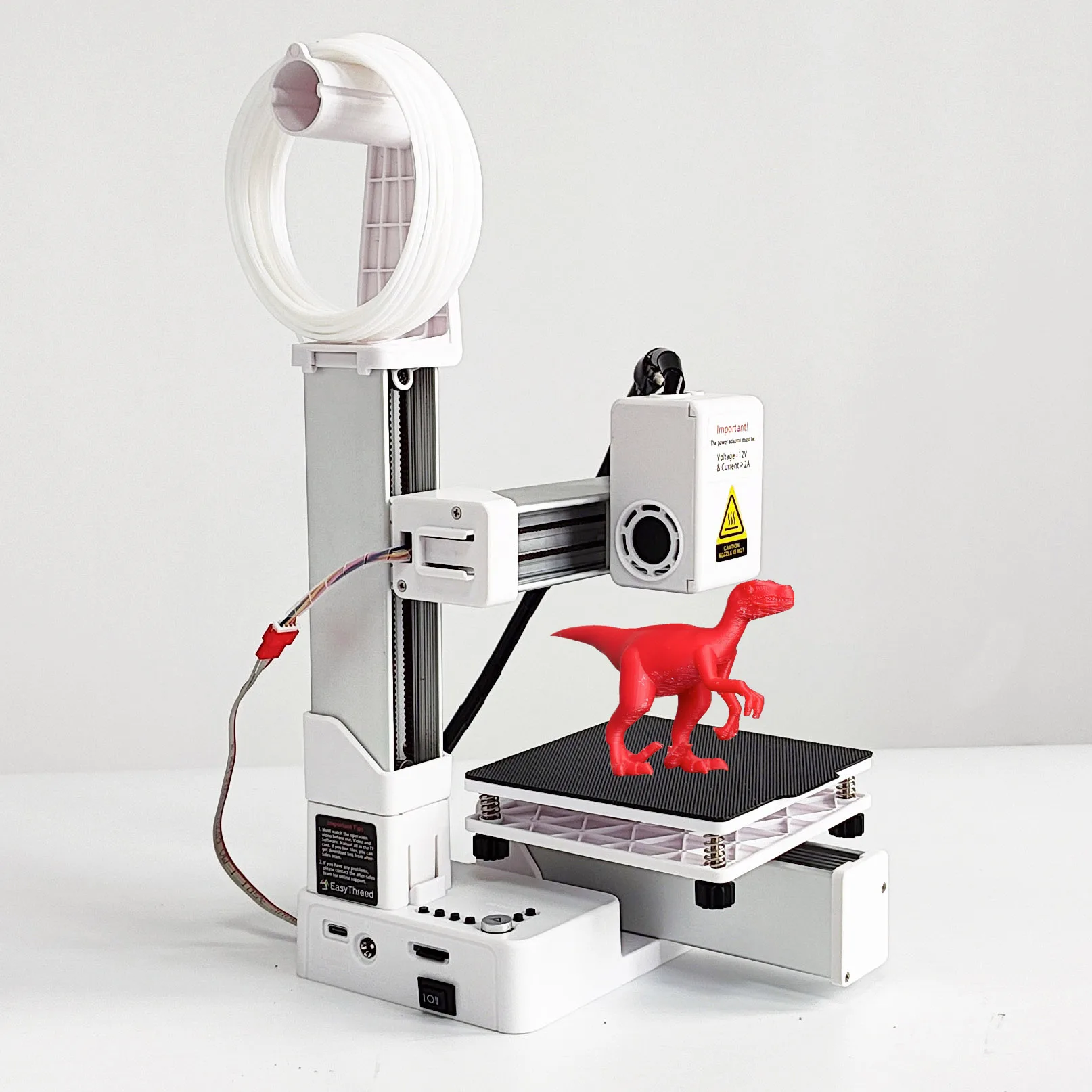
EasyThreed Entry-Level 3D Printer
The EasyThreed is a minimalist, ultra-compact open-cantilever printer built around a small footprint and simple button-driven operation, supplied with an external 12V power adapter. It lists baseline compatibility with standard 1.75 mm PLA and flexible TPU filaments.
- Target User: Students, educators, or absolute beginners exploring basic additive manufacturing concepts on a strict budget.
- Practical Compromises: The small cantilever Z-axis gantry, unheated or basic bed, and manual leveling screws limit dimensional tolerance and material choices. It is strictly suitable for small decorative or low-stress PLA models.
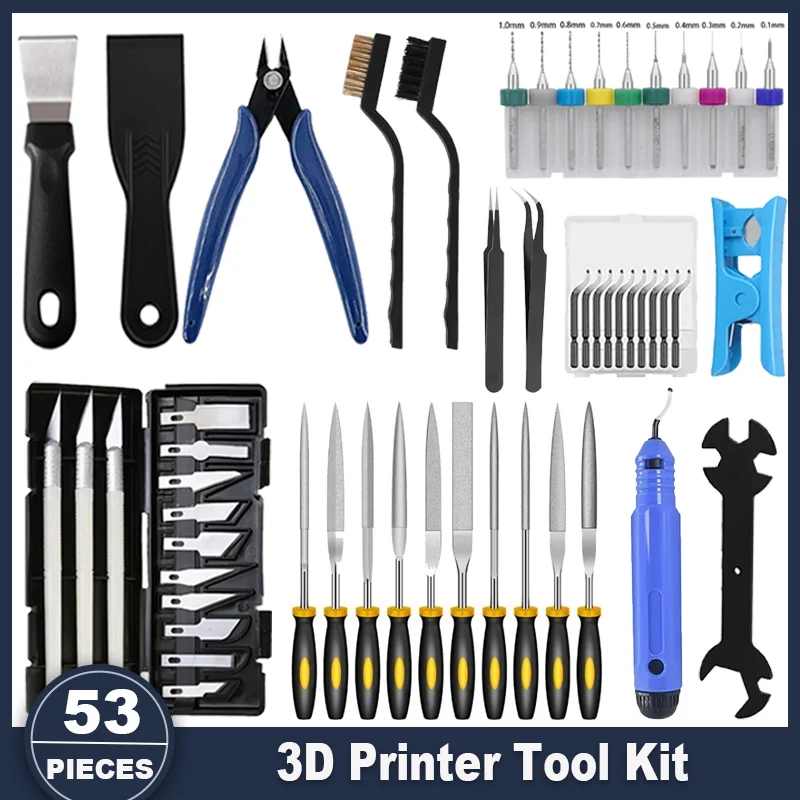
53-Piece FDM / SLA Maintenance & Post-Processing Kit
Regardless of machine automation, everyday FDM operation requires post-print cleanup and periodic mechanical clearance. This multi-piece accessory bundle includes deburring scrapers, flush wire cutters, fine nozzle clearing needles (from 0.1 mm to 1.0 mm), miniature brass and nylon brushes, hobby knives, and multi-profile deburring files.
- Target User: Any printer owner needing dedicated tools for clearing partial hotend clogs, removing tree supports, and deburring brim lines.
- Practical Compromises: Clearing needles should only be introduced when the hotend is heated to target melting temperatures to prevent snapping thin wire inside the nozzle throat. Always follow machine-specific thermal maintenance guides.
FDM Feature Comparison
| Model | Motion / Form Factor | Multi-Color Capability | Leveling Approach | Primary Role |
|---|---|---|---|---|
| Anycubic Kobra 4 / Combo | Bed-moving Cartesian | Up to 8 colors (Combo variant) | Sensor automated offset | Fast multi-color & figurines |
| Flashforge Adventurer 5M | Enclosed-chassis open frame | Single filament | Full-auto one-click leveling | Rapid mechanical prototyping |
| Flashforge AD5X | Enclosed-chassis open frame | Integrated multi-filament feed | Automated bed leveling | Multi-hue technical parts |
| EasyThreed Mini | Open cantilever arm | Single filament manual load | Manual thumbscrew leveling | Introductory hobby education |
Pre-Purchase Verification Checklist
Because third-party marketplace listings frequently combine multiple sub-variants (e.g., bare printer vs. combo package with filament feeder), review these specific points before purchasing:
- Included Package Variants: Confirm whether the listing price covers the multi-color external feeder box (such as the Anycubic ACE module) or only the standalone machine.
- Build Volume and Power Grid: Check whether the machine's internal power supply is autosensing (100–240V) or requires toggling a manual mechanical switch (115V vs. 230V) before first powering on. Operating an incorrectly set supply can permanently damage machine electronics.
- Bed Surface Material: Ensure the printer includes a removable spring steel PEI sheet. Fixed glass or adhesive tape beds require considerably more scraping and manual re-leveling.
- Firmware and Slicer Freedom: Check whether the machine uses an open standard G-code slicing workflow (like OrcaSlicer, PrusaSlicer, or Cura) or enforces proprietary, closed cloud-slicing software for network jobs.
Modern FDM 3D printing offers higher initial reliability than ever, provided you evaluate mechanical kinematics honestly and account for the real filament waste and calibration needs of multi-material setups.
Evaluation is based on published specifications and seller listings. No physical or hands-on testing was conducted; unlisted specifications may still be available from the seller.